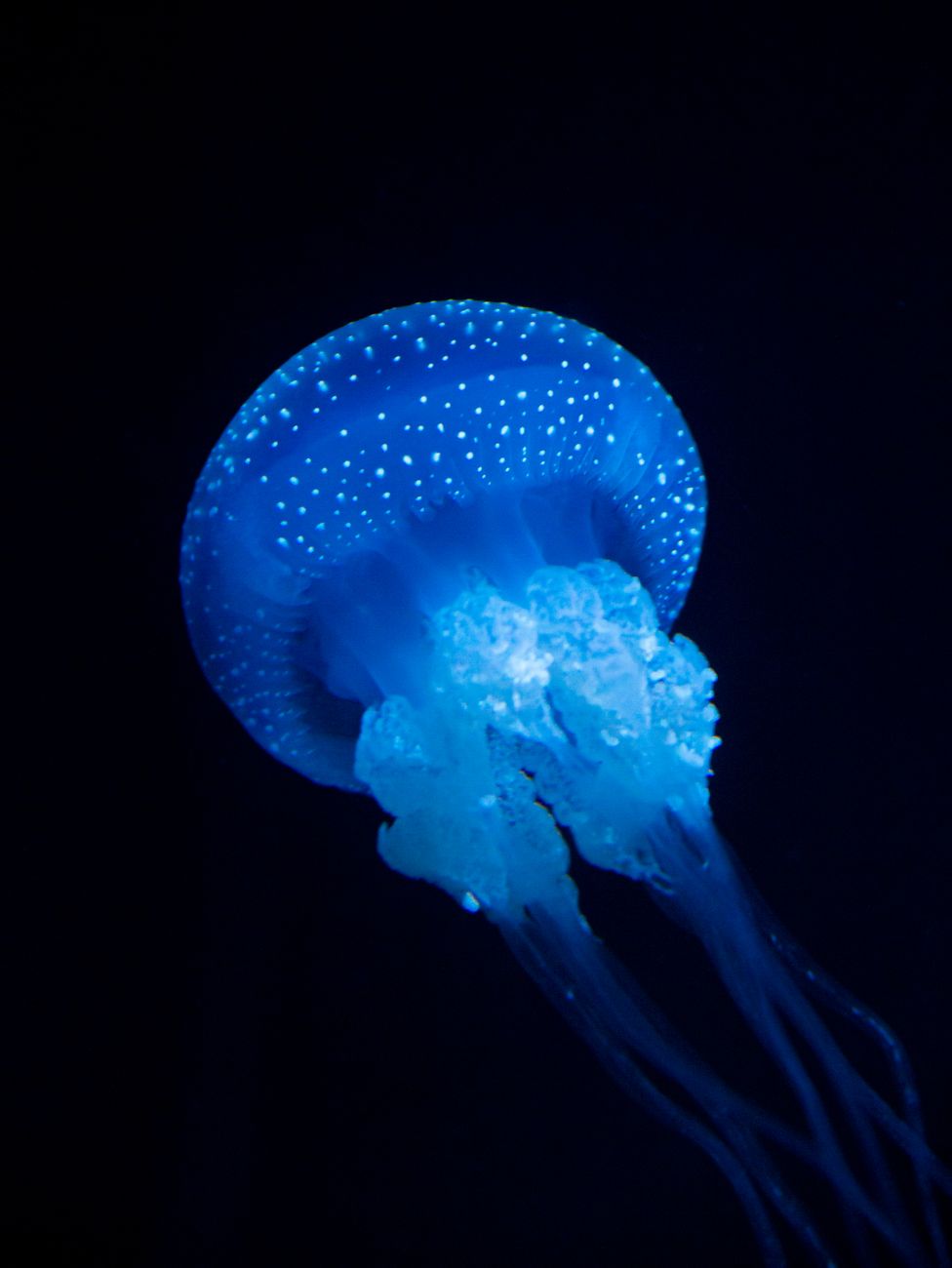
If matter is the field when it’s fully occluded with no inside luminosity, it raises another question. Your body is made of the same matter as the rock, the same dark occluded stuff, but you’re illuminated on the inside. We may not be sure if other organisms are conscious, but we know our own body is. What is it that makes living matter different from non-living?
An influential way to understand the difference is called autopoiesis, which means self-creation (auto: self and poiesis: creation). Autopoietic systems are self-contained. This doesn’t mean they don’t need anything from outside themselves, but that the system itself produces the ingredients it needs to sustain its existence.
A cell is the most basic autopoietic unit. It’s a circular loop, a process of self-generation. It has a metabolic network that creates the ingredients it needs. This network not only replaces all the ingredients that are constantly being used or destroyed, it also maintains a permeable boundary between itself and the world.
A cell continuously re-creates the boundary that differentiates it from everything else. Autopoiesis is the self’s boundary when it’s seen from the outside. Inside the boundary is the individual and outside is the field. The boundary itself is the interface.
Seen from the outside, the difference between a rock and a living body is movement: movement that’s self-directed rather than pushed by an external force. Think of how you decide if something is alive or not, if it moves independently you know it’s alive.
This self-directed movement is when matter comes alive. We saw that the individual self was a pattern in the luminous field and the boundary was a density boundary. A density boundary in a dynamic field means the tempo or movement varies. That is the same boundary we find in living systems.
What the biologist sees as matter moving in a particular pattern is, from the inside, the individual maintaining itself. Autopoiesis describes the organisation of the system, not its elements. The difference between a living system and the matter it’s composed of isn’t a difference of substance, but of how the matter is organised and moves. The particular organisation is the pattern that defines what kind of system it is.
A living body is matter moving to sustain itself in existence. In terms of our field metaphor, we’d say it’s moving to maintain its own pattern, the same way a standing wave holds its shape through constant motion.
The functions of a living body are like the movements you make on a swing. You make a slight push of your arms and legs to sustain your pattern and in that way you maintain your standing wave. The movements of living systems are more complex, but they’re the same adjustments of movement that sustain your standing wave in the field.
A boundary that continually creates itself must be permeable. It needs ingredients from outside to rebuild itself, so elements must be able to pass through the boundary, from self to world and world to self. The boundary creates the self, and in living systems the self continually creates its own boundary. You are constantly replenishing your own skin. Without the boundary there is no self, but without the world there is no boundary. The self and the world are interdependent.
But this self-creating boundary has a feature the swing doesn’t. Without maintenance, the swing slows and stops, but its motion can be restarted. A living boundary that stops maintaining itself doesn’t just stop, it dies. Life’s self-creation isn’t an optional motion.
The organism has various biological pressures – hunger, fatigue, threats – and it needs to coordinate its functions to avoid system failure. Each pressure puts a strain on the system. The strain is a measure of how far that particular need is from being met and how urgently it requires correction. The longer since you’ve eaten or slept increases the strain.
A living organism can’t rely on an external manager, because an outside force can’t repair it if it stops functioning. Death is irreversible. A boundary that must continually correct itself to avoid its own failure needs internal feedback and regulatory mechanisms. The strain has to register somewhere and there is nowhere outside the system for it to register. But registering inside a boundary isn’t the same as being felt. A thermostat registers, but its internal mechanism isn’t felt.
Why feeling is necessary
Not all regulatory signals are felt. Many systems maintain homeostasis automatically. Your heart rate and respiratory rate adjust without your control. The pH in your blood is kept in a tight range and your temperature is kept in check with automatic responses. If it’s too hot you sweat, if it’s too cold you shiver. When the relationship between the correct response and the situation is fixed, the process runs without any input from us.
These automatic biological processes sit at the matter end of the luminosity dial, only now it’s in a single organism. Heartbeat, blood pH, thermo-regulation, these are all fixed, hard-wired processes that happen at the occluded end.
The hard-wired processes that don’t require any choice or behavioural input from us are unconscious. But where the correct action isn’t settled and some kind of choice is needed, that’s where the light shines through.
If you need food but the food is in front of a lion, taking it can get you killed. Weighing of options is needed. The fear registers but so does the hunger. There are competing imperatives and no fixed solution, so it can’t be hard-wired. There’s no common metabolic scale which can be wired to say, this much hunger vs this much fear = this output.
When there’s only one right response, it can be hard-wired: a reflex, or a thermostat that engages the correct output to deal with the problem. Machinery can run it if there’s nothing to be weighed. But if a mechanism weighs hunger against fear, what sets the weighting the mechanism uses? If weighting is done by another mechanism, what sets the weighting that second mechanism uses, and the one after that?
Mechanism alone isn’t enough. It sets off a regress, because if all we have is mechanism, each one requires a further weighting mechanism. In a purely mechanical system it can only bottom out in a hard-wired rule, which stops the regress but can’t weigh anything. Real weighing has to bottom out somewhere the stakes are presented directly, and self-presentation is the distinctive feature of consciousness. In a living body, that self-presenting medium is feeling. The stakes are felt, not passed to another rule.
Feeling is needed when the correct behaviour isn’t fixed, because it provides a scale that allows comparison. The feeling comes with a pressure to act: it motivates with a particular intensity and urgency. That intensity is the strain. If you desperately need food to survive, the hunger might be weighed higher than the fear: the existential stakes mean it’s worth the risk to steal the predator’s food. If the hunger is mild and there’s an option to pick berries, the fear is weighed as the greater danger. When the answer to the biological problem requires weighing stakes and there’s no common physical unit compare them, the stakes must be presented in a common currency. Feeling is the common currency.
The direction of the strain
The biological stakes being weighed not only have an intensity or urgency, they have a direction. They either point toward collapse or away from it toward health. This direction is called valence. The valence of some feelings is inviting, you seek them out. Others cause avoidance behaviour. Pain is the most obvious example. Pain is a signal of danger to the body system, and you move away from whatever causes it. Valence isn’t something extra to the regulatory signals; it’s the direction the signal points.
If we describe valence as pure direction all we can say is the organism moved away from the stimulus causing the pain. As a function, valence can only mean direction: this state is heading toward collapse or away from it. This is survival bookkeeping and none of it needs feeling.
But if we say the organism found the stimulus bad, the felt quality of pain as bad isn’t given in the data. We know pain is bad because that data is given by our own experience. In a naturalist metaphysics, this is where a conflation happens and it’s subtle and often passes by unnoticed: valence is labelled good and bad as though the felt quality is available for free.
Because it’s so obvious to us that pain is bad, this is silently carried over to the mechanism and the behaviour, which is why the conflation often passes unnoticed. That relabelling of direction as good is exactly where the hard problem of consciousness is found. The feeling isn’t found in either the biological mechanism or the direction the organism moves and those are the only properties available to a naturalist metaphysics.
On a consciousness-first view, the feeling is already there, since the field itself is conscious. The direction and the feeling are the same event seen from two sides of the boundary. From the outside or biological side we have: this direction is heading toward system collapse. From inside the boundary the same direction is experienced as: this feels bad. Together, strain and valence tell you how much danger you’re in and which way you’re heading.
How the world lights up
We’ve been looking at how the self holds its boundary together, correcting against its own collapse. But the self also needs a permeable boundary. A cell sealed off from the world is a dead cell, so the self can’t stop at the edge. It extends beyond, taking in what it needs and expelling what it doesn’t.
A living boundary isn’t a wall; it’s an interface. When we have a self with existential stakes that’s interacting with the world, the world itself takes on significance. The simplest example is a bacterium. The bacterium swims toward higher concentrations of sugar. The chemistry itself contains no food and no feeling. Chemistry is only molecules and their concentrations. But from the perspective of the bacterium, as a self with biological needs, sugar is food.
The difference between sugar as food and sugar as chemicals isn’t in the bacterium or the chemistry. It’s in the relation between them. That relation is between a being that must maintain itself and a world that either feeds that maintenance or doesn’t. The world is now divided into better and worse and it divides that way “for” a self.
This is the light of the subject illuminating the world through the boundary. The light on the inside of the boundary is felt as strain and valence, the intensity and direction of a biological need. But the same light permeates beyond the boundary through the senses, and when it does, it illuminates the things in the world that meet that need. The light outside the boundary illuminates the value of things in the world. Sugar becomes food. A predator becomes a threat.
The value doesn’t depend on the urgency of the need, only on whether the organism has the need. Sugar is food whether you’ve just eaten or you’re starving. But strain and valence position the need on a scale. Strain tells us how urgent the need is, and valence tells us where it sits on the scale from good to bad. The hungrier you are, the more valuable sugar becomes. The more exposed you are, the more dangerous the predator is.
Sugar isn’t valuable in itself, and the bacterium doesn’t invent its value. The self doesn’t cast meaning onto a meaningless world; the self’s senses are an aperture shaped to the need, tuned to highlight the feature in the world that answers it. The value is in the relation itself, not in the organism or the world.
The loop runs both ways
This is a dynamic sensorimotor loop. The world doesn’t arrive pre-arranged into significance: what the bacterium senses depends on how it moves, and how it moves depends on what it senses. The bacterium swims in a straight line, then tumbles and heads off in a new direction. If it senses an increase in the concentration of sugar it continues in the same direction, if the concentration is declining it tumbles and reorients itself.
The same thing happens when you feel your way through a dark room. What you feel determines the direction you move next and the direction you move determines what you feel. If you feel the wall in front of you, you reorient yourself and reach out in another direction.
Every sensorimotor interaction is the self’s perspective in motion. Its movement is toward maintenance or away from collapse, and its senses light up the features of the environment that carry that existential significance. But the loop doesn’t make the perspective, it’s where an already luminous interior gets aimed at the world.
That means perception isn’t passive reception. Perception maps the contours of the world into shades of significance for the self. The result is a world “for” me.
Each sensory apparatus is an aperture with a particular shape. Different apertures highlight different regions of the world, so different senses light up a different world. The shape of the aperture doesn’t just point at part of the world, it determines what comes through. Nothing outside that shape is illuminated. It’s structurally excluded, not merely in shadow. The bacterium has one aperture, shaped to illuminate sugar.
As organisms become more complex, the apertures do as well. Beyond chemical receptors, eyes, ears and increasingly complex cognitive structures develop. A richer set of apertures means a richer world is illuminated. Dogs can hear sounds well above the range of human hearing. That isn’t the dog hearing the same world as us; it’s the dog’s aperture letting through parts of the world that our hearing can’t access.
This is why what it’s like to be a bat is different from what it’s like to be a human. The bat isn’t passively receiving our world in a different hue. It has a different aperture and so a different region of reality lights up for the bat. Sonar doesn’t show our world in a different modality. It shows a world organised around echo and interval, facts our eyes were never equipped to register as significant. A sense that isn’t built to highlight a feature simply leaves it dark, it can’t enter into our awareness.
The senses of each organism illuminate a world of its own. We each look out on the same field, but the world that lights up is ours alone.

