We can think of the various relationships to the Absolute with a familiar example. A monarch is one person who has many different relationships. His citizens relate to him in an impartial way, they don’t know him by name or have access to his private life. Their interactions are indirect and only concerned with the functioning of the public environment.
Moving closer to the king we have his public servants. They interact with a person but in a formal relationship. They may address him by his title, Your Majesty, rather than his name. But they have some knowledge of his personal preferences, how he likes to organise his day, and they accommodate that in their service.
Closer still are his friends. Now there is equality between persons. You’d call him by his first name, and you may give him an affectionate nickname and tease him. You’d know his personal likes and dislikes.
Once we reach personal relationships, the king’s position of power has receded into the background. His power remains intact, but it’s inactive and ignored because its presence would impede the friendship. In personal relationships there must be an equality between persons.
As we move even closer, we come to the king’s family. This is a more intimate depth of relationship. Parents serve their child. You’d pander to him and try to please him. But you may also discipline and advise him. Now the power of the king has not only been eclipsed, it’s been reversed. The parents protect him as if he was helpless. Even closer than this is a spouse. You know him in an even more intimate way, and he willingly reveals his mind and heart to you.
These modes of intimacy aren’t descriptions of emotions. They’re degrees of self-disclosure and surrender of our will to the beloved’s will. Nor is this a relativism in which any relationship with the Absolute is equal and merely a matter of opinion. These stages of relationship don’t represent psychological states, they describe the structure of reality. Moving closer means moving toward what is most fundamental, as physics moves from surface mechanics to deeper field structures, not merely warmer in feeling.
There is no greater unity that retains difference and respects the sovereignty of each individual. This is oneness within relationship. The beloved is ours, as dear, or more dear to us, than our own self. And we belong to our beloved in the same way.
We’re willing to give our whole self and sacrifice our own pleasure for the well-being of our beloved. And this is a dynamic state. As we please the beloved, this sparks an impetus in them to please us, and this movement continues in a self-perpetuating and leapfrogging embrace. We become one. The movement of consciousness and will becomes completely entwined and moves in an increasingly fulfilling direction.
Will is the inherent movement of consciousness and is dynamic in nature. Love then, is the ultimate form of oneness: not a static oneness, but a mutual relational oneness that is infinitely deep, endlessly dynamic, and by its nature overflows to inundate everything in its path.
Love moves the way light moves
Not a single beam pushing in one direction, but a self-sustaining exchange where each pulse attracts and calls forth a response. Nothing holds the exchange together but the exchange itself. Love itself is the generative principle. Love is self-sustaining and reveals the deepest heart of the personal reality.
That’s what it means to participate in the highest good. It’s not something we observe from a distance, or merely align with. Relationship is participation, it’s reciprocal by nature. Love is the highest mode of that participation because in love each will freely offers itself to the other and the good is shared and amplified in a dynamic and reciprocal exchange.
Love is the supreme controlling principle of all reality. Even the all-powerful Absolute bows down to love and surrenders control to its natural flow. Power isn’t the ruling principle. Love is.
Love then, is the deepest expression of the nature of the Absolute. It’s the quintessence of consciousness and only finds its complete expression in the infinite and absolute consciousness. For it’s only in the infinite that we can find complete knowledge, complete existence, and complete and everlasting joy.
Reason can show us the Absolute must be a person and capable of love. But reason can’t place us inside the relationship it describes. Love isn’t an intellectual endeavour, it’s an orientation of the will. What does it mean to stand at the threshold reason has reached but cannot cross?
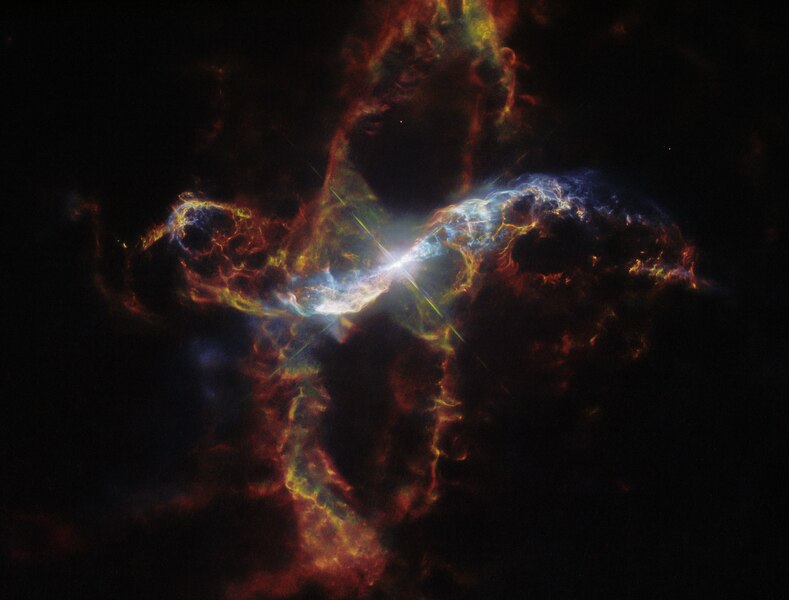
Lead image: R Aquarii, a symbiotic binary star system. Credit: NASA/ESA (ESA/Hubble), Stute et al. CC BY 4.0.

